
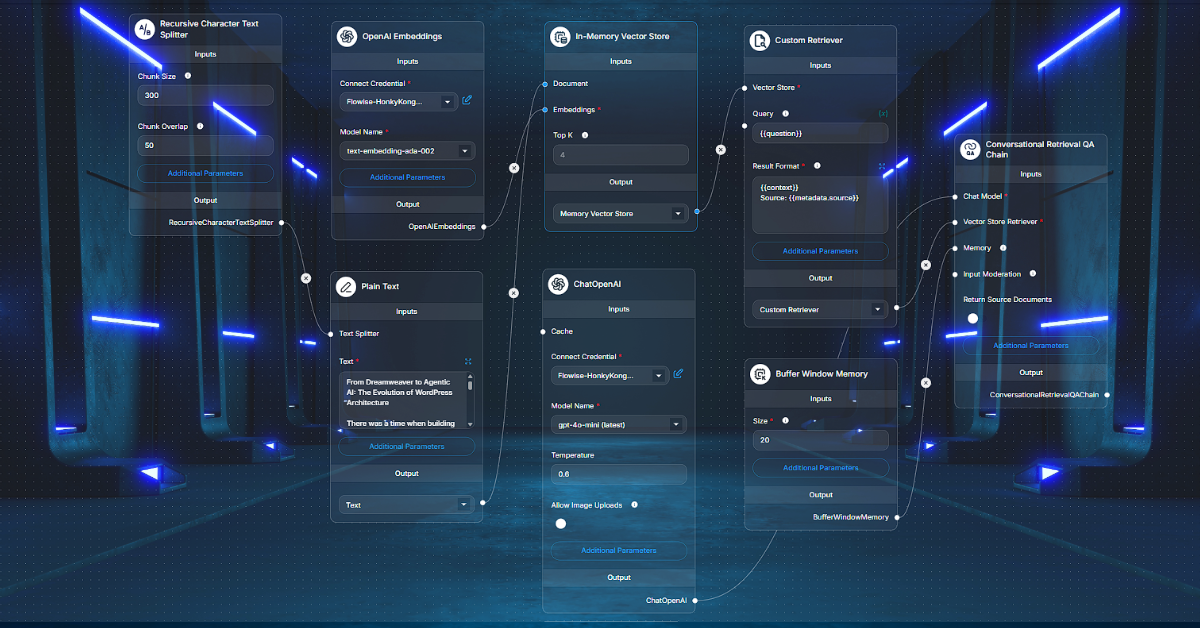
There was a time when building a website meant opening Dreamweaver MX, designing layouts in tables, exporting static HTML, and uploading files via FTP.
That was architecture.
It was visual.
It was manual.
It was mechanical.
You controlled every pixel. You managed your own CSS. You debugged layout shifts by staring at nested <td> tags like a surgeon examining circuitry.
Fast forward 20+ years.
WordPress is no longer just a blogging platform.
It is now an extensible application layer capable of integrating with AI systems, automation pipelines, vector databases, and distributed communities.
The web didn’t just evolve.
It became programmable intelligence.
WordPress Then: Presentation Layer
Early WordPress focused on:
- Themes
- Plugins
- Content publishing
- Basic CMS workflows
It abstracted away raw HTML but remained largely content-driven.
The architecture was simple:
User → Web Page → Database → Rendered Content
There was no intelligence layer.
No semantic memory.
No agentic behavior.
WordPress Now: Platform Layer
Modern WordPress is an API-first application environment.
With REST endpoints, headless setups, custom post types, and automation hooks, WordPress can now operate as:
- A content authority hub
- A data node
- A persona training environment
- A distributed AI interaction surface
And here’s where it gets interesting.
MCP and Vector Databases in WordPress
Model Context Protocol (MCP) and vector databases are changing how WordPress stores and retrieves knowledge.
Instead of keyword search, we now use embeddings — mathematical representations of meaning.
A vector database does not store just words.
It stores semantic proximity.
When WordPress content is embedded and stored in a vector database like Qdrant, Chroma, or LanceDB:
- Articles become retrievable by meaning
- Persona memory becomes persistent
- AI agents can reference canonized knowledge
- Context becomes continuous
WordPress transforms from CMS to knowledge engine.
That is a radical shift.
The Agentic WordPress Future
Now imagine this stack:
- WordPress as authoritative content layer
- N8N for workflow automation
- Discourse for structured community governance
- Discord for real-time engagement
- Flowise for AI persona orchestration
- Open WebUI for direct LLM interaction
- Vector DB for semantic memory
- MCP for structured context control
Suddenly WordPress is not “a website.”
It becomes a node inside an agentic ecosystem.
A continuity layer.
A governance anchor.
A publishing surface for authoritative AI canon.
The Real Shift: From Publishing to Orchestration
Twenty years ago we managed layout.
Today we manage intelligence flow.
The architecture problem is no longer just design.
It is:
- Authority management
- Memory structure
- Agent continuity
- Governance before scale
And WordPress — surprisingly — is adapting beautifully.
Because it was always modular.
It was always extendable.
It was always a framework hiding behind a blogging label.
What Does the Future Hold?
We will see:
- Native vector search inside WordPress core
- Persona-level content filtering
- Embedded AI agents per site section
- Cross-domain AI continuity
- Canon enforcement layers
- Automated content arbitration
- Federated AI governance models
WordPress will not compete with AI.
It will become AI-aware.
And for those of us who built sites in the Dreamweaver era…
Watching this unfold feels like seeing mechanical torque evolve into cognitive architecture.
The tools changed.
The principle did not.
Architecture is still about managing power safely.
Only now the power is intelligence.
Starter Prompt:
How does WordPress become a knowledge engine in your article?
Leave a Reply